
Shipping a car long distance doesn’t have to be expensive. This guide explains how intermodal freight works in simple terms and when it can help you save money. You’ll learn how to choose the right option, avoid hidden costs, and decide if slower—but cheaper—shipping is the best fit for your situation.
Table of Content:
- What Is Intermodal Freight Service in Simple Terms?
- Why Do People Choose Intermodal Instead of Full Truck Shipping?
- How Does Intermodal Shipping Actually Work Step by Step?
- What Role Do Rail Terminals (Ramps) Play in Intermodal Shipping?
- What Is a Drayage Carrier (Drayman) and Why Does It Matter?
- What Types of Containers Are Used in Intermodal Shipping?
- How Do Market Conditions Affect Intermodal Pricing?
- When Is Intermodal Shipping the Best Option for Saving Money?
- When Should You Avoid Intermodal Shipping?
- What Are the Hidden Costs People Often Miss?
- How Can You Reduce Your Intermodal Shipping Costs?
- How Can YK Freight Help You Save on Intermodal Shipping?
What Is Intermodal Freight Service in Simple Terms?
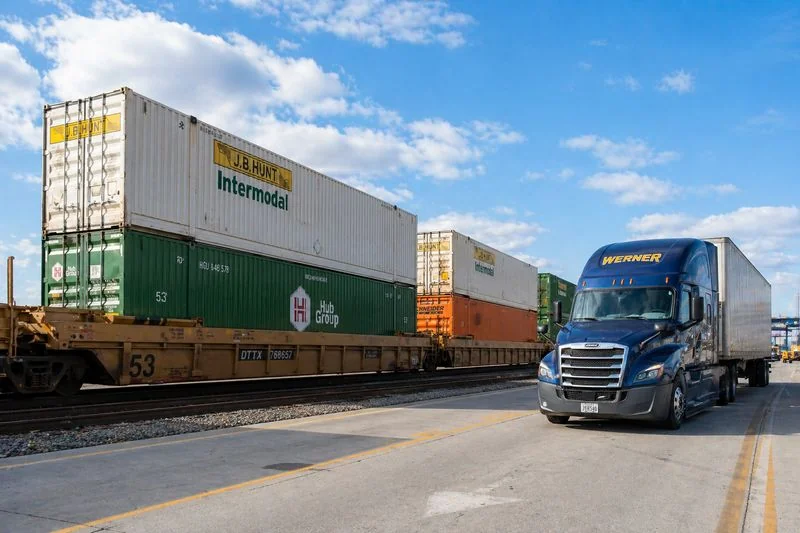
Intermodal freight service means using more than one type of transportation to move your shipment from point A to point B. Most often, it’s a combination of truck + train + truck.
Instead of a single truck driving the entire distance, your vehicle is loaded into a container, moved part of the way by rail, and then delivered by truck at the end. The key idea is simple: each part of the trip is handled by the most cost-efficient transport option.
For people trying to save money on shipping, this approach can make a big difference—especially on long distances.
How Does Intermodal Shipping Actually Work?
Here’s how the process usually looks in real life:
- A truck picks up your vehicle and brings it to a rail terminal (also called a ramp)
- The vehicle is loaded into a container and placed on a train
- The train moves it across a long distance without stops
- At the destination terminal, another truck picks it up
- The vehicle is delivered to the final address
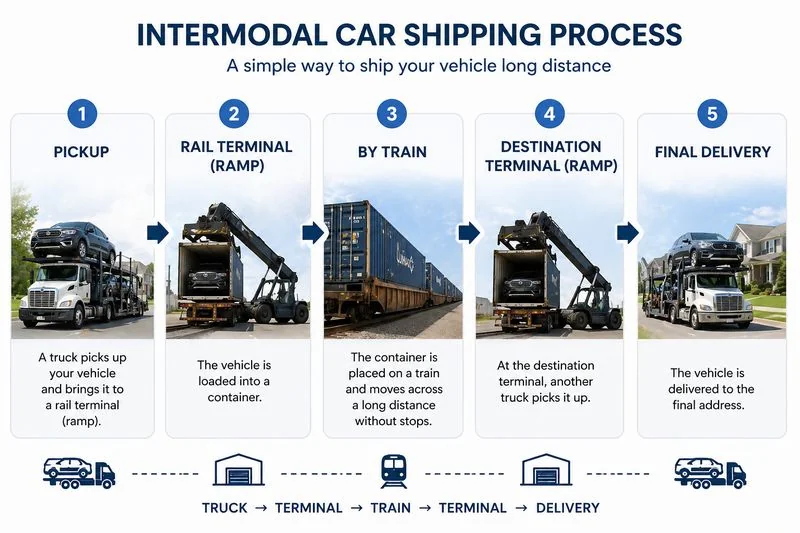
You’re still getting door-to-door delivery. The only difference is that the long middle part is handled by rail instead of a truck.
This setup helps reduce costs because trains can move large volumes of freight more efficiently than trucks over long distances.
Real Example: Shipping a Car from Georgia to California
Let’s say you bought a car at an auction in Georgia and need to ship it to California—but you don’t want to overpay for full truckload transport.
A direct truck delivery across the country is fast, but it can be expensive. If you're on a budget, intermodal becomes a smarter option.
Here’s what that shipment might look like:
- A local truck picks up the car in Georgia and delivers it to a nearby rail terminal
- The car is loaded into a container and travels by train across several states
- When it reaches California, another truck picks it up from the rail yard
- The car is delivered to your location
The total delivery time may be a bit longer compared to a full truckload service. But the cost is usually lower—sometimes significantly lower.
Why Do People Choose Intermodal Instead of Full Truck Shipping?
For most customers, the decision comes down to one simple question: do you want faster delivery or lower cost?
Full truckload (FTL) shipping means one truck carries your vehicle all the way from pickup to delivery. It’s direct, flexible, and usually faster. But that convenience comes at a higher price—especially over long distances.
Intermodal shipping, on the other hand, splits the journey between truck and rail. It may take a bit longer, but it often costs less. That’s why many people choose it when they’re trying to stay within a budget.
How Does Intermodal Compare to Full Truckload (FTL)?
Here’s a simple way to understand the difference:
- FTL (Full Truckload):
- One truck handles the entire route
- Faster delivery
- More flexible scheduling
- Higher cost, especially cross-country
- Intermodal (Truck + Rail):
- Combination of truck and train
- More structured schedule
- Slightly longer transit time
- Lower cost on long distances
If speed is your priority, FTL is the better option. If saving money matters more, intermodal is usually the smarter choice.
When Is Intermodal Cheaper?
Intermodal becomes more cost-effective as the distance increases.
For short trips, the extra steps (loading, unloading, rail handling) can actually make intermodal more expensive or not worth the effort. But for long-distance shipping—like across multiple states—rail transport significantly reduces the cost per mile.
Intermodal is typically cheaper when:
- The route is long (for example, East Coast to West Coast)
- You don’t need urgent delivery
- The route connects major rail hubs
- There is good container availability
This is why many budget-conscious buyers choose intermodal for cross-country vehicle shipping.
When Is Intermodal NOT the Best Option?
Intermodal is not always the cheapest or most practical solution.
It may not work well if:
- You need fast delivery within a few days
- The pickup or delivery location is far from rail terminals
- The route is short (where trucking is more efficient)
- There are delays in rail schedules or container availability
In these cases, a direct truck shipment may actually save you time—and sometimes even money.
Real Example: Saving Money on a Non-Urgent Shipment
Imagine you just bought a car from an auction in another state. You’re not in a hurry—you just want it delivered safely without overpaying.
You check two options:
How Does Intermodal Shipping Actually Work Step by Step?
Intermodal shipping may sound complicated, but the basic process is simple. Your vehicle does not stay on one truck for the whole trip. Instead, the route is divided into several parts, and each part is handled by the most practical transport method.
For long-distance vehicle shipping, this usually means truck + rail + truck.
Step 1: Pickup by Truck
The process starts with local pickup.
For example, you buy a car at an auction in Georgia and need to ship it to another state. A truck comes to the auction yard, picks up the vehicle, and takes it to the nearest suitable rail terminal.
This first truck move is usually short compared to the full route. Its job is not to drive across the country. Its job is to connect the auction location with the rail network.
Step 2: Delivery to the Rail Ramp
Next, the vehicle is delivered to a rail ramp, also called a rail terminal.
This is where the shipment is prepared for the rail portion of the trip. Depending on the shipping setup, the vehicle may be loaded into a container or prepared for rail movement through the correct equipment and procedures.
Rail ramps are important because they affect both cost and timing. If the auction is close to a major rail terminal, the first truck leg may be cheaper. If the location is far from the ramp, that short truck move can add extra cost.
Step 3: Rail Transport Across the Long Distance
After the vehicle reaches the rail ramp, the long-distance part of the trip begins.
This is where intermodal can help reduce costs. Trains can move large amounts of freight over long distances more efficiently than trucks. Instead of paying for a truck to drive hundreds or thousands of miles, the shipment moves by rail for the main part of the route.
For example, your auction vehicle may travel from Georgia toward the West Coast by train. This part may take longer than direct truck delivery, but it can be more affordable.
Step 4: Final Delivery by Truck
Once the rail portion is complete, the vehicle arrives at the destination rail terminal.
From there, another truck picks it up and delivers it to the final address. This could be your home, a dealership, a warehouse, or another agreed delivery point.
This last truck move is also usually short. Just like the pickup leg, its purpose is to connect the rail terminal with the final destination.
Real-Life Example: Shipping an Auction Car Across States
Let’s say you buy a used car at an auction in Georgia and need it delivered to California. A direct truck shipment may be faster, but the price could be too high for your budget.
With intermodal shipping, the process may look like this:
- A truck picks up the car from the auction yard in Georgia
- The car is taken to a rail ramp
- The vehicle moves across the country by train
- Another truck picks it up from the destination rail terminal
- The car is delivered to your address in California
What Role Do Rail Terminals (Ramps) Play in Intermodal Shipping?
Rail terminals—often called ramps—are one of the most important parts of intermodal shipping. They are the points where cargo moves between trucks and trains.
If you think of intermodal shipping as a chain, ramps are the key connection points that make the whole system work.
What Is a Rail Ramp in Simple Terms?
A rail ramp is a specialized facility where containers and trailers are transferred between trucks and trains.
It’s not just a regular rail yard. It’s built specifically for intermodal operations and includes:
- Areas for loading and unloading containers
- Storage space for containers and chassis
- Controlled entry and exit gates
- Equipment for lifting heavy containers
This is where your shipment switches from road transport to rail—and back again.
Without ramps, intermodal shipping wouldn’t exist.
What Happens at the Ramp?
When your vehicle arrives at the ramp, several things happen before it continues its journey:
- The container or shipment is checked and inspected
- It is prepared for rail transport
- Specialized equipment lifts it onto a railcar
- It is secured for long-distance movement
These facilities use large machines (like cranes or lifts) designed to handle heavy containers quickly and safely.
The process is efficient, but it requires proper infrastructure—which is why not every location has access to it.
Why Doesn’t Every Location Have a Rail Ramp?
Rail ramps are expensive to build and operate. They require:
- Large amounts of space
- Specialized equipment
- Strong rail network connections
- High shipping volume to justify the cost
Because of this, ramps are usually located near major cities, ports, or logistics hubs.
If your pickup or delivery location is far from a ramp, your shipment will need extra trucking to reach one. This can increase both cost and transit time.
How Ramp Location Affects Price and Delivery Time
The distance to the nearest rail ramp plays a big role in how efficient your shipment will be.
Here’s how it impacts your shipment:
- Closer to a ramp = lower cost and faster handling
- Far from a ramp = higher cost due to extra trucking (drayage)
- Well-connected routes = more reliable schedules
- Less common routes = potential delays or limited availability
For example, shipping a car from a major logistics hub like Atlanta is usually more efficient because there are multiple rail terminals nearby. But if the vehicle is located in a remote area, it may require a longer truck trip just to reach the rail network.
What Is a Drayage Carrier (Drayman) and Why Does It Matter?
In intermodal shipping, drayage is the short-distance trucking part of the journey. A drayage carrier, or drayman, is the company or driver responsible for moving your shipment between key points—usually between a rail terminal and the pickup or delivery location.
Even though this part of the trip is short compared to the full route, it plays a critical role in how your shipment is priced and delivered.
What Is Drayage in Simple Terms?
Drayage is simply local transport.
In an intermodal setup, your vehicle doesn’t go directly from pickup to destination by train. It needs trucks at both ends:
- One truck moves the vehicle from the pickup location to the rail ramp
- Another truck moves it from the destination ramp to the final address
These short trips are handled by drayage carriers.
Think of drayage as the “first mile” and “last mile” of intermodal shipping.
Why This “Small Part” Matters More Than You Think
It’s easy to focus only on the long rail portion of the trip, but drayage can significantly impact:
- Total shipping cost
- Delivery time
- Overall reliability
If everything is well planned, drayage is quick and efficient. But if not, it can create delays and unexpected costs.
For example:
- If trucks are not available at the right time, your shipment may sit at the terminal
- If the location is hard to access, extra handling may be required
- If scheduling is off, you may miss a rail departure window
So even though drayage is a smaller part of the route, it can affect the entire shipment.
How Distance from the Rail Ramp Affects Cost
One of the biggest factors in drayage pricing is distance.
If your vehicle is close to a rail terminal, the drayage cost stays low. But if it’s far away, the cost increases because the truck has to travel more miles.
Here’s a simple example:
- Pickup location near a major city with a rail ramp → lower drayage cost
- Pickup location in a rural or remote area → higher drayage cost due to longer truck distance
The same applies at the delivery end.
In some cases, the extra trucking cost can reduce the savings you get from using rail. That’s why distance planning is so important.
Real-Life Example: Hidden Costs from Poor Planning
Let’s say you bought a car at an auction in a small town, far from any major rail terminal.
At first, intermodal shipping looks cheaper than direct trucking. But once the drayage is added:
- A long truck trip is needed just to reach the rail ramp
- Another long trip is needed after the rail portion
- Additional handling and scheduling may be required
Now the price difference becomes smaller—or in some cases, not worth it.
This is a common situation for buyers who only look at the rail portion and forget about the local transport on both ends.
How YK Freight Helps Optimize Drayage
This is where proper coordination makes a big difference.
A company like YK Freight plans the entire route, not just the rail portion. This includes:
- Choosing the most efficient rail ramp
- Reducing unnecessary trucking distance
- Coordinating pickup and delivery timing
- Avoiding delays at terminals
What Types of Containers Are Used in Intermodal Shipping?
In intermodal shipping, your vehicle or cargo doesn’t move on its own—it moves inside a container. These containers are what make it possible to switch between trucks and trains without unloading and reloading the shipment at every step.
There are several types of containers used in intermodal transport, and the type available can affect both price and delivery time.
Carrier-Owned Containers
Some logistics companies and intermodal providers operate their own container fleets.
These containers are used within their network and are usually easier to schedule if you’re working directly with that provider. The advantage is better coordination and fewer delays, since the company controls both the container and the movement.
However, availability still depends on location. If there are no containers in your area, one may need to be repositioned, which can increase cost.
Railroad Containers
Railroads also manage their own container pools.
These are used specifically for rail transport and are widely available on major routes. If your shipment is moving between large logistics hubs, railroad containers are often the most efficient option.
They are designed for fast loading, unloading, and high-volume movement. This makes them a good fit for standard intermodal routes where demand is consistent.
Ocean Shipping Containers
Ocean containers are typically used for international shipments, but they can also be part of domestic intermodal transport—especially when a shipment is connected to import or export.
These containers are owned by shipping lines and move between ports and inland locations.
They can create both opportunities and challenges:
- If there are many incoming shipments to a region, containers may be easy to find and cheaper to use
- If there is a shortage, containers may need to be moved empty from another location, increasing cost and delays
Why Container Availability Matters
No matter which type of container is used, availability is one of the biggest factors affecting your shipment.
If a container is ready and available near your pickup location:
- Your shipment can move faster
- Costs stay lower
If there are no containers nearby:
- You may have to wait for one to arrive
- Extra costs may apply to reposition equipment
- Your shipment may be delayed
Simple Example: Delays Due to Container Shortage
Imagine you buy a car at an auction in a region where there are not many outbound shipments.
At first, everything looks fine. But when it’s time to schedule transport, there are no available containers in that area.
Now one of two things happens:
- You wait until a container becomes available
- Or a container is brought in from another location, increasing your cost
How Do Market Conditions Affect Intermodal Pricing?
Intermodal pricing is not fixed. It changes depending on what’s happening in the transportation market.
Several key factors influence how much you’ll pay—and sometimes even whether intermodal is the best option at all. The most important ones are truck capacity, fuel prices, rail service availability, and overall demand.
In simple terms:
when trucking becomes more expensive, intermodal usually becomes more attractive.
How Does Truck Capacity Impact Price?
Truck capacity means how many trucks are available compared to how many shipments need to be moved.
- When there are plenty of trucks, prices stay lower
- When trucks are in short supply, prices go up
This often happens during peak seasons, like holidays or busy auction periods.
When truck rates increase, intermodal becomes a more affordable alternative because the long-distance portion shifts to rail, which is less affected by driver shortages.
What Role Do Fuel Prices Play?
Fuel is a major cost in trucking.
- When fuel prices go up, trucking becomes more expensive
- When fuel prices go down, trucking becomes more competitive
Rail transport is generally more fuel-efficient over long distances, so it doesn’t react as sharply to fuel price increases. That’s another reason intermodal can offer savings when fuel costs rise.
How Does Rail Service Availability Affect Costs?
Rail service also has its limits.
If rail networks are running smoothly with good capacity:
- Intermodal is easier to schedule
- Transit times are more predictable
- Costs stay stable
But if there are delays, congestion, or limited space on trains:
- Prices can increase
- Transit times may get longer
- Availability becomes tighter
Even though rail is efficient, it still depends on infrastructure and scheduling.
How Does Demand Influence Intermodal Pricing?
Like any service, pricing depends on demand.
- High demand for intermodal → higher prices and limited availability
- Lower demand → better pricing and more options
Demand often increases when trucking becomes expensive. Many shippers switch to intermodal at the same time, which can push prices up if capacity is limited.
Simple Rule: When Trucks Get Expensive, Intermodal Wins
All these factors connect in a simple way:
When:
- Truck capacity is tight
- Fuel prices are high
- Trucking rates increase
→ Intermodal becomes the more cost-effective choice.
When:
- Trucking is cheap and widely available
→ The price gap between trucking and intermodal becomes smaller.
Real-Life Example: Budget Shipping Decision
Let’s say you’re shipping a car across several states.
At first, truck shipping seems like the easiest option. But during a busy season, you notice that truck rates have gone up.
Now you check intermodal:
Since you’re not in a rush, you choose intermodal and save money.
When Is Intermodal Shipping the Best Option for Saving Money?
Intermodal shipping is not always the cheapest option—but in the right situations, it can significantly reduce your total transport cost.
The key idea is simple: you save money by allowing more flexibility in how and when your vehicle is shipped.
When Does Intermodal Make the Most Sense?
Intermodal works best in specific conditions where cost matters more than speed.
Here are the most common situations where it’s a smart choice:
- Long-distance shipping
The longer the route, the more you can save. Rail becomes more efficient over hundreds or thousands of miles, especially compared to full truck delivery. - Flexible timelines
Intermodal relies on train schedules and terminal handling, which means it’s less flexible than direct trucking. If you can wait a bit longer, you can take advantage of lower pricing. - Non-urgent vehicles
If you don’t need the car immediately, intermodal is a strong option. Many buyers are willing to trade a few extra days for meaningful savings. - Routes between major logistics hubs
Shipping between cities with strong rail connections (like Atlanta, Chicago, Dallas, Los Angeles) is usually more efficient and cost-effective.
Why These Conditions Matter
Intermodal is designed for efficiency, not speed.
Trains move large volumes of freight at a lower cost per mile, but they operate on fixed schedules and require coordination at terminals. This creates small delays compared to direct trucking—but also creates savings.
If your situation fits these conditions, intermodal allows you to benefit from that efficiency.
Real-Life Example: Saving Money by Waiting
Let’s say you bought a car at an auction and need it delivered across the country.
You get two options:
- Full truck delivery: faster, but more expensive
- Intermodal shipping: slower, but cheaper
You’re not in a rush—you just want the car delivered safely without overspending.
By choosing intermodal, you wait a few extra days, but you save a few hundred dollars on shipping.
For many buyers, especially those already paying for auction fees, repairs, or export costs, that saving makes a real difference.
The Bottom Line
Intermodal shipping is the best option when:
When Should You Avoid Intermodal Shipping?
Intermodal shipping can help you save money—but it’s not the right choice in every situation.
If your priority is speed, flexibility, or simplicity, a direct truck shipment may be a better option. Understanding these limitations helps you avoid delays and unexpected costs.
When You Have a Tight Deadline
Intermodal shipping depends on train schedules and terminal operations. This means your shipment has to fit into a fixed system, not a flexible one.
If you need your vehicle delivered quickly:
- You may not be able to catch the next available train
- Your shipment could wait at the terminal
- Transit times can vary depending on rail schedules
In urgent situations, full truckload shipping is usually faster because the vehicle moves directly from pickup to delivery without stops or transfers.
When Pickup or Delivery Is in a Remote Area
Intermodal works best when both the pickup and delivery locations are close to major rail terminals.
If your vehicle is located far from a rail ramp:
- Extra trucking (drayage) is required
- Costs increase
- Transit time may be longer
The same applies at the delivery end. If the destination is remote, the final truck leg becomes longer and more expensive.
In some cases, these extra costs can cancel out the savings from using rail.
When the Distance Is Short
Intermodal is designed for long-distance efficiency.
For shorter routes:
- The time spent loading, unloading, and transferring may not be worth it
- The cost difference between intermodal and trucking becomes smaller
- Direct trucking is often simpler and just as affordable
If the shipment is only going a few hundred miles—or within the same state—full truckload shipping is usually the better choice.
Real-Life Example: Fast Delivery Within One State
Let’s say you bought a car from a dealer in Georgia and need it delivered to another city in the same state.
You need the vehicle quickly—maybe within a day or two.
In this case:
- Intermodal would require moving the car to a rail terminal
- Waiting for a train schedule
- Handling additional transfers
All of this adds time and complexity.
A direct truck shipment, on the other hand, can pick up the vehicle and deliver it quickly without extra steps.
The Bottom Line
You should avoid intermodal when:
What Are the Hidden Costs People Often Miss?
Intermodal shipping can be cheaper—but only if you understand the full cost, not just the main rail portion.
Many buyers look at the base price and assume that’s the final number. In reality, several smaller charges can be added along the way. These are not “hidden” in a bad sense—they’re just often overlooked.
If you don’t plan for them, your total cost may end up higher than expected.
Drayage Fees (First and Last Mile Trucking)
Drayage is the short-distance trucking at the beginning and end of the route.
This is one of the most common extra costs.
You pay for:
- Pickup from the auction or seller to the rail ramp
- Delivery from the destination ramp to your final location
If both locations are close to rail terminals, the cost stays low. But if they are far away, the price increases.
Example:
You buy a car at an auction outside a major city. At first, the intermodal quote looks cheap. But the auction is 120 miles from the nearest rail ramp. That extra trucking distance adds noticeable cost to your shipment.
Storage Fees at Rail Ramps
Rail terminals are not long-term storage facilities.
If your vehicle stays at the ramp longer than allowed, storage fees may apply. This can happen for several reasons:
- Delays in scheduling the next transport step
- Missed pickup appointments
- Lack of available trucks for final delivery
Example:
Your car arrives at the destination terminal, but you’re not ready to receive it, or delivery hasn’t been scheduled yet. After a certain number of free days, the terminal starts charging daily storage fees.
Even a short delay can add unexpected costs.
Container Repositioning (Empty Miles)
Sometimes there are no available containers in your area. When that happens, a container must be brought in from another location.
This is called repositioning—and it can increase your price.
Why it happens:
- Low shipping volume in your region
- Imbalance between inbound and outbound shipments
- High demand for containers in other areas
Example:
You’re shipping from a smaller market where there aren’t many outgoing shipments. There are no containers available nearby. A container has to be moved empty from another city before your shipment can start.
This adds extra cost and may delay the process.
Why These Costs Add Up
Individually, these charges may not seem significant. But together, they can reduce the savings you expected from intermodal shipping.
This is especially important for budget-conscious buyers who are trying to control total expenses—not just the base rate.
Real-Life Scenario: Budget Buyer Surprise
Imagine you’re trying to save money by choosing intermodal instead of full truck delivery.
You see a lower base price and decide to go with it. But later:
- Drayage is higher than expected due to distance
- The vehicle sits at the ramp for a few extra days
- A container had to be repositioned
Now your final cost is much closer to the original truck quote.
This situation is common when the route is not planned carefully.
The Smart Approach
To avoid surprises, it’s important to look at the total route, not just one part of it.
Experienced companies like YK Freight factor in:
How Can You Reduce Your Intermodal Shipping Costs?
Intermodal shipping can already be a cost-saving option—but with the right approach, you can reduce your expenses even more.
Most savings come from smart planning, not luck. Small decisions about timing, location, and routing can make a noticeable difference in your final price.
Ship Between Major Cities Whenever Possible
Routes between large logistics hubs are usually the most efficient.
Major cities have:
- Better access to rail terminals
- More frequent train schedules
- Higher container availability
This reduces both cost and delays.
If your shipment starts or ends in a smaller town, try to:
- Choose the nearest major city for pickup or delivery
- Or accept a slightly longer local drive to reduce overall shipping cost
Example:
Shipping from Atlanta to Los Angeles is usually more cost-efficient than shipping from a small rural area to a remote destination.
Book Early Instead of Waiting
Last-minute shipping often costs more.
When you book early:
- You have more scheduling options
- It’s easier to secure container space
- You avoid peak demand pricing
Waiting too long can lead to:
- Higher rates
- Limited availability
- Longer delays
Simple rule: the earlier you plan, the more control you have over the price.
Stay Flexible With Dates
Flexibility is one of the easiest ways to save money.
Intermodal depends on fixed rail schedules. If you can adjust your timing:
- You can fit into available capacity
- You avoid rush fees
- You reduce the chance of delays
Example:
If you’re okay with shipping your car a few days later, you may get a better rate than someone who needs immediate pickup.
Choose a Company That Plans Routes Efficiently
Not all intermodal routes are equal.
A poorly planned route can include:
- Long drayage distances
- Unnecessary transfers
- Delays at terminals
All of this adds cost.
A well-planned route focuses on:
- Shorter truck legs
- Efficient rail connections
- Available containers in the right locations
This is where experience matters.
How YK Freight Helps You Save More
Companies like YK Freight don’t just book shipments—they plan them.
This includes:
- Selecting the best rail terminals for your route
- Reducing unnecessary trucking distance
- Checking container availability in advance
- Coordinating timing between each step
The goal is simple: make sure intermodal actually saves you money, not just looks cheaper at first.
How Can YK Freight Help You Save on Intermodal Shipping?
Intermodal shipping can save money—but only when the route is planned correctly. Without proper coordination, small inefficiencies can quickly add extra costs.
That’s where a company like YK Freight makes a real difference. Instead of just booking a shipment, they focus on building the most efficient route from start to finish.
How Does Route Planning Reduce Your Costs?
Not every intermodal route is equally efficient.
YK Freight analyzes:
- Distance to the nearest rail ramps
- Available rail connections
- Container availability in your area
- The balance between truck and rail legs
The goal is to avoid unnecessary mileage and extra handling.
For example, choosing the wrong rail terminal might add 100+ miles of trucking. A better-planned route can reduce that distance and lower your total cost.
Why Cost Transparency Matters
One of the biggest concerns for budget-conscious customers is unexpected charges.
YK Freight focuses on clear, upfront pricing, including:
- Drayage (first and last mile trucking)
- Rail transport
- Potential handling or storage factors
This helps you understand the real total cost, not just the base rate.
Instead of surprises later, you can make an informed decision from the beginning.
How Truck + Rail Are Combined Efficiently
Intermodal works best when each part of the route is used correctly.
YK Freight coordinates:
- Timely pickup to match rail schedules
- Efficient transfer at rail terminals
- Proper timing for final delivery
This reduces:
- Waiting time at ramps
- Missed train departures
- Extra storage or handling fees
The result is a smoother process with fewer delays.
How Drayage and Coordination Are Managed
Drayage may seem like a small part of the shipment, but it can have a big impact on cost.
YK Freight handles:
- Scheduling trucks for pickup and delivery
- Minimizing distance between locations and ramps
- Coordinating timing between all steps
This prevents common issues like:
- Long idle time at terminals
- High local trucking costs
- Miscommunication between carriers
A Practical Solution for Budget Shipping
For someone trying to save money, intermodal can be a smart option—but only if it’s done right.
YK Freight simplifies the process by:
- Planning the full route, not just one part
- Keeping costs predictable
- Avoiding unnecessary expenses
- Managing all steps in one place
Instead of dealing with multiple carriers and unclear pricing, you get a structured solution that focuses on one goal: helping you save money without creating extra complications.
Further Reading
What is Intermodal Trucking?
Intermodal vs FTL Trucking: Which Freight Option is Right for You?
What Is Cargo Consolidation and How It Saves You Money on Shipping
When to Use Intermodal Transportation for Cost-Effective Shipping


ASK YOUR QUESTIONS